
If your security posture boils down to “buy new laptops,” you don’t have a strategy. Read as a whole, it’s a hysterical security sermon that reduces messy supply-chain reality to a plastic NPU talisman. It flatters executives who want a pop remedy instead of architectural accountability.
Publisher: Tech Monitor
“How to stop worrying and love the AI PC” is a clown-shoes headline. It promises therapy, delivers a shopping list. If your security posture boils down to “buy new laptops,” you don’t have a strategy, you have procurement panic.
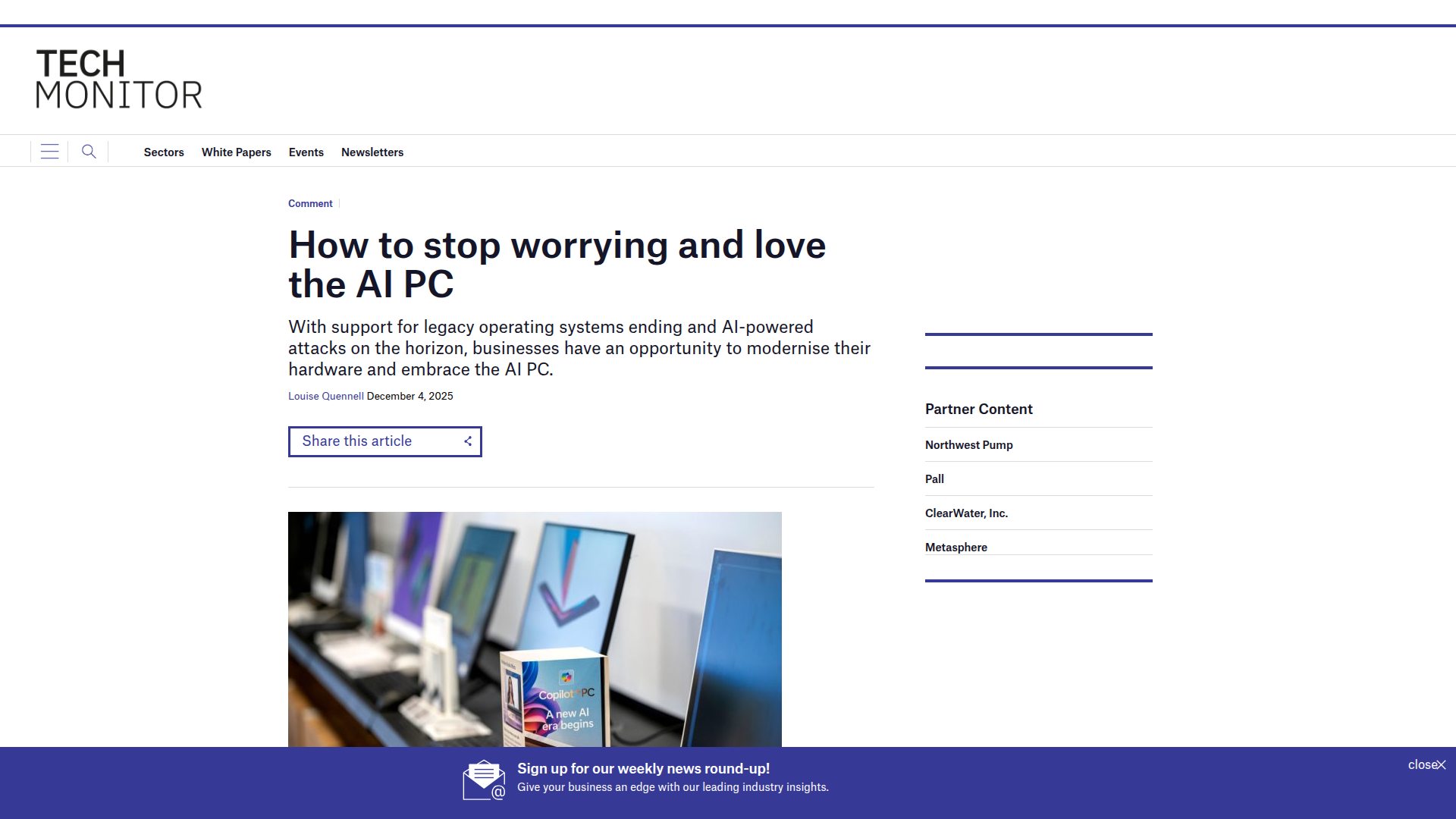
This thing reads like the Dell marketing team’s diary. The author is a Dell director, the disclosure is practically invisible, and the tone is classic advertorial. Tech Monitor apparently nodded it through, newsletter traps and a staged Best Buy glamour shot included. Amateur hour.
Evidence is missing where it matters. No breach data tied to “old CPUs.” No perf numbers for typical SLM workloads on NPU vs CPU. No TCO, no deployment complexity, no patch cadence for firmware or models. Big claims, zero measurements. That’s marketing, not engineering.
The technical core is just as sloppy. NPUs run inference faster. That’s it. They don’t harden a compromised kernel, block userland exfiltration, or stop a malicious binary from hammering the accelerator. “On-device” does not magically equal “sovereign” or “compliant.” Sovereignty is law, process, and operational discipline. Treating silicon as a legal fix is cargo cult nonsense.
The security name-drops are shallow. TPM, secure boot, attestation—fine, foundational even—but all contingent on firmware supply chain integrity and sane admin controls. One sloppy vendor, one bad peripheral, one over-privileged user, and your shiny attestation story collapses. Zero trust is identity, segmentation, monitoring, and response. You don’t get that by unboxing a new laptop.
It also pretends cost and sustainability don’t exist. A mass refresh creates e‑waste, provisioning churn, migration pain, and helpdesk load. Hand-waving that away is either naive or deliberately convenient.
Read as a whole, it’s a hysterical security sermon that reduces messy supply-chain reality to a plastic NPU talisman. It flatters executives who want a pop remedy instead of architectural accountability. If you’re going to push a fleet refresh as a security imperative, show hard data and trade-offs. Otherwise, stop wasting everyone’s time.