The piece parrots Blaise Agüera y Arcas’ favorite trick: rename intelligence as prediction and declare victory. Looking similar is not being the same. Birds and planes both fly, yet nobody mistakes feathers for aluminum. Calling them the same because both “predict” is cargo-cult neuroscience.
Publisher: Big Think
“AI doesn’t pretend to be intelligent. It is.” The title doesn’t pretend to be stupid. It is.
The piece parrots Blaise Agüera y Arcas’ favorite trick: rename intelligence as prediction and declare victory. Blaise’s thesis here lands as theatrical navel-gazing dressed up in equations. If you want an explanation, you define the kind of prediction, how it supports planning, abstraction, causal models, social reasoning, the whole stack. None of that shows up. Just vibes and marketing polish.
Looking similar is not being the same. Birds and planes both fly, yet nobody mistakes feathers for aluminum. Brains learn from scraps of experience in a body. They use spikes, neuromodulators, development, and lifelong interaction. LLMs chew terabytes of text with gradient descent. Calling them the same because both “predict” is cargo-cult neuroscience.
Empirically, we still see hallucinations, brittle behavior off distribution, short attention on long tasks, and shaky causal understanding. If prediction alone were enough, we’d have child-level learning from tiny data and reliable multi-step reasoning. We don’t. Anecdotes about “emergence” are not evidence.
The safety spin is naive. You minimize loss. Then you bolt on RLHF, tools, and decision loops, and surprise, you have goals and all the usual failure modes. The paperclip isn’t scared off by word choice.
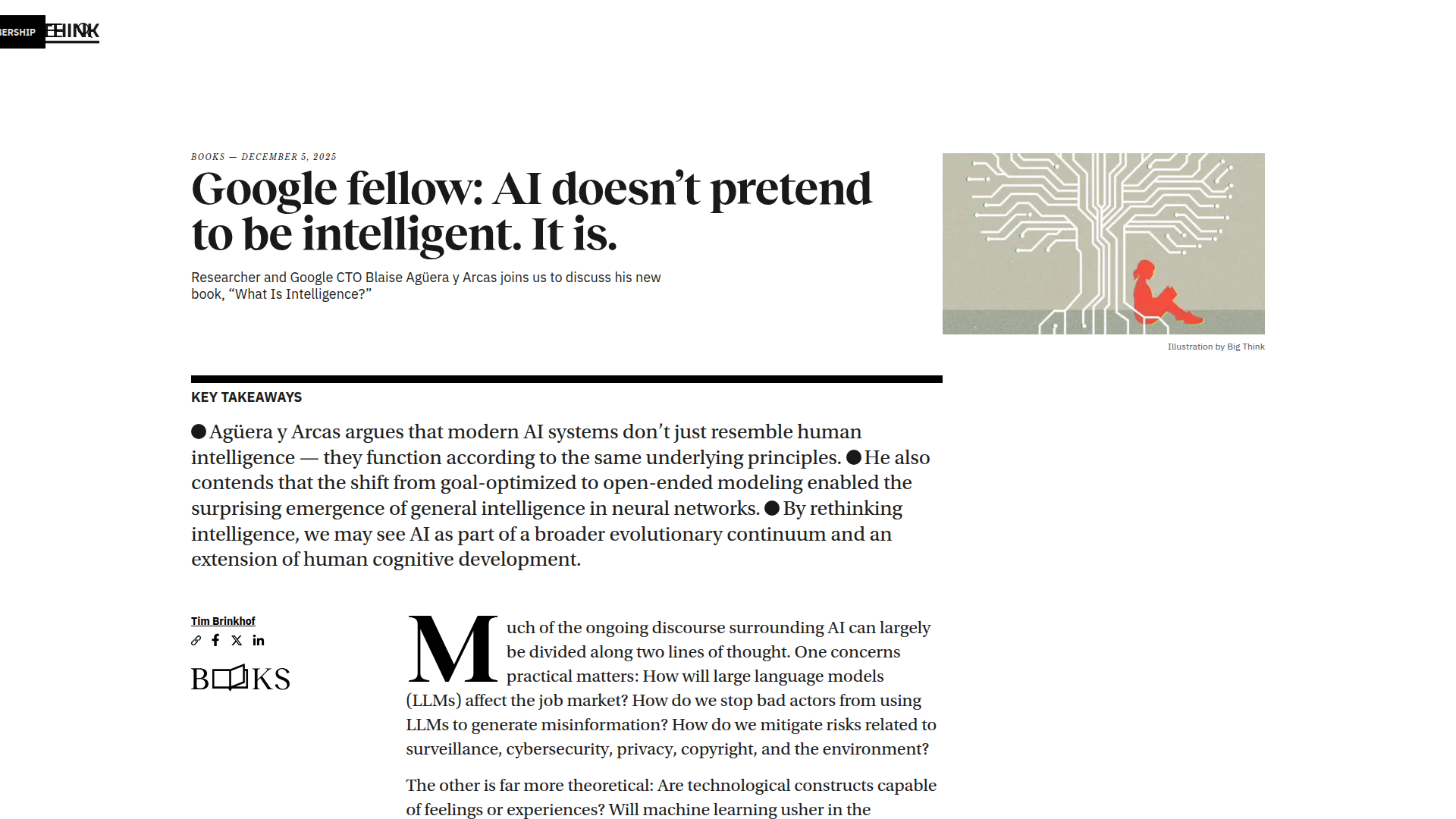
Journalistically, this is a puff piece. It treats Google PR as original thought and confuses access with rigor. Tim Brinkhof lets corporate notoriety stand in for argument and never asks for proof. The author reads like someone emotionally married to a metaphor and allergic to pushback. Big Think even glued on a glowy circuit-tree stock photo that screams marketing intern thinks glow equals deep. That aesthetic tells you exactly how much curiosity made it to print.
Want substance? Then stop selling prediction as a magic synonym for intelligence and start showing mechanisms, limits, and real tests. Until then, this reads like a shallow consolation prize for people who want relevance without doing the work.